In this article
“Open” is an incomplete description of an ATM destination. A machine can be available inside a business whose doors are locked, inside a lobby reached through a separate entrance, or beyond a public concourse with its own schedule. The relevant opening time is the time of the entire path you can use, not the most generous number attached to the building.
A practical visit plan therefore needs an entrance description as well as an address. This is particularly important when traveling before work, after a late shift, on a weekend, or during a holiday. The question is not whether a venue is usually busy at that hour. It is whether the exact route to the terminal is available to you during the window you intend to arrive.
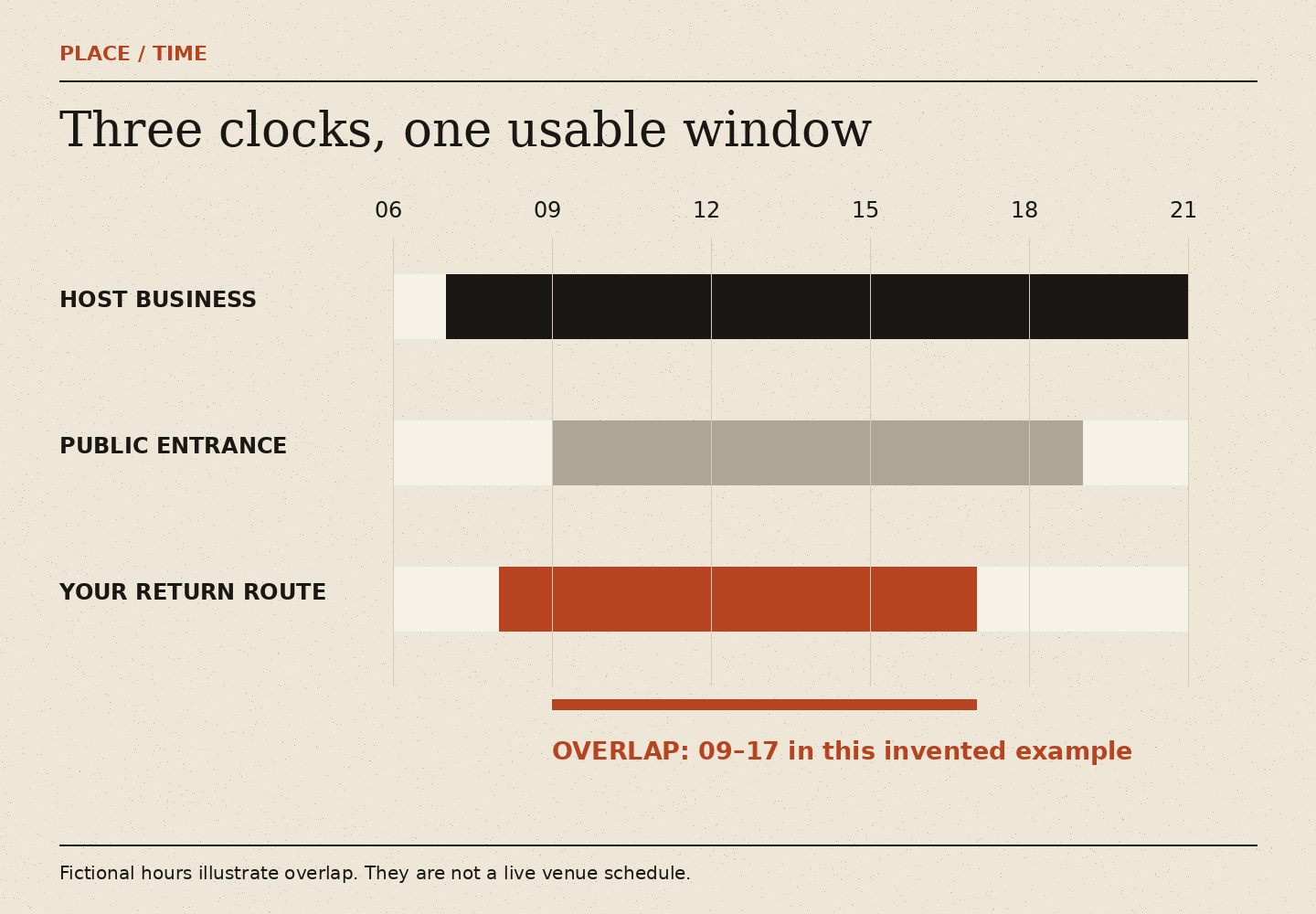
Separate the three clocks
The first clock belongs to the host business: its ordinary customer hours. The second belongs to the space containing the terminal: a vestibule, internal corridor, reception area, or separate room. The third belongs to your journey: when you can arrive and still leave by the route you need. These clocks may overlap only partly. Planning with only the first one can hide a narrow usable window.
In a fictional example, a market advertises a 7 a.m. opening. Its street entrance opens then, but the indoor arcade entrance opens at 9 a.m. A nearby bus stop serves the arcade side. A reader arriving at 7:20 may technically be at an open business yet still face a long walk around the building. If that walk is unsuitable, the distinction matters more than the advertised opening time.
Write each clock separately before combining them. “Business opens at seven; terminal is by the street entrance; bus arrives on the arcade side” is more informative than “ATM opens at seven.” It also gives a person answering a phone a concrete misunderstanding to correct. If you cannot confirm the location of the machine inside the venue, that remains an open question.
Ask an entrance question that someone can answer
A venue employee may not know the card network or withdrawal rules. They may know exactly which door opens early. Ask for public place information: whether the machine is inside or outside, which public entrance reaches it, and whether that entrance follows the business’s ordinary schedule. You do not need to explain your balance, employment, or reason for needing cash.
Avoid broad questions such as “Will the ATM work?” That asks the employee to predict equipment behavior and card authorization. A narrower question is more useful: “Can a visitor reach the ATM from the main public entrance at that time?” If they cannot confirm, ask whether another venue contact manages access. Do not turn a polite guess into a firm assurance.
Sometimes the answer includes an access restriction: ticketed premises, a staff-only building, a membership area, or a door intended only for customers of a particular service. Treat the restriction as part of the destination. A map pin does not confer permission to enter. Nor does a card logo establish that a locked door will admit you. Choose another arrangement rather than trying to defeat a restriction.
Build a usable window, not a precise arrival fantasy
An arrival estimate is a point. A useful visit window allows for ordinary variation. Consider the time needed to reach the correct entrance, find the machine, wait without disrupting the venue, read unfamiliar prompts, and leave. The amount of margin is personal and situational; this article does not prescribe a universal number of minutes.
Work backward from the condition you cannot move. If the last suitable bus departs at a fixed time, ask whether the cash visit still fits after a modest delay. If a venue is about to close, consider whether there is enough time to enter and finish without pressure. A plan that requires every stage to happen at its best-case speed is fragile even when each stage is individually plausible.
For the fictional market, arriving shortly after the street entrance opens may work for a reader approaching from that side. It may not work for the reader whose route ends at the locked arcade. The difference is the path, not a better or worse financial decision. Once the path is explicit, changing the visit window or selecting another venue becomes easier to evaluate.
Regular hours are not exception hours
A weekly schedule is a baseline. Holidays, maintenance, special events, weather, and building work can create exceptions. The practical question is which source has information about the date and entrance that matter. A business’s official notice may address a holiday closure while a general directory still shows ordinary hours. A temporary sign may describe a door change that never reaches a map service.
You cannot eliminate every exception beforehand. Instead, decide which one would be costly enough to check. A long rural trip deserves more entrance verification than a casual stop beside an errand you already need to make. This is a proportional research decision. It does not require giving the venue personal information or asking staff to reserve cash.
Avoid interpreting silence as confirmation. If a website says nothing about an upcoming holiday, record that the holiday schedule is unconfirmed. If an employee describes usual hours rather than the date you asked about, distinguish the two. A precise note about an uncertain condition is more useful than a confident but unsupported conclusion.
A doorway record you can reuse
Keep a short record with the venue name, the public entrance description, the terminal’s position relative to that entrance, the schedule source, and the date checked. Add a line for the limitation: “Ordinary hours only; no current machine-status confirmation.” The record is a route aid, not proof of entitlement to use the machine or evidence of a particular fee.
After a visit, update only what you observed. “The side entrance was locked at 8:10 on this date” is a sound observation. “This ATM is never available before nine” may be an unjustified generalization. If the venue later supplies corrected hours, keep the source distinction clear. The goal is a more accurate next visit, not a permanent verdict about a business.
The official Corpay Prepaid locator can be a starting point for finding candidate places. Its public page is not evidence that any particular door is open now. Treat location discovery and entrance verification as separate tasks. The strongest address is the one you can translate into a usable doorway during your own visit window.
Sources and limits
Public sources checked October 14, 2026. The methods, fictional places and illustrations are original editorial work. No source review establishes live terminal availability, venue access, card eligibility or guaranteed cost.
- Corpay Prepaid ATM locator · Public candidate-location interface; no location submitted, no live terminal status, access or eligibility verified.