In this article
Cash has two dimensions: total value and physical form. A successful withdrawal can provide the right total while leaving you unable to complete the intended errand. A cash-only stall may have little change at opening. A machine used for another purchase may require particular notes. A group activity may need several small contributions rather than one large bill. Thinking about denominations before traveling can prevent the cash visit from becoming only the first half of a longer problem.
This is not a recommendation to withdraw more, make repeated withdrawals, or buy something to obtain change. It is a way to define the output you need. The available notes and choices depend on the terminal, its configuration, and current conditions. This publication has no live denomination inventory and does not promise that a particular machine offers note selection.
Translate the errand into a physical requirement
Start with what the recipient or cash-using activity actually requires. “Cash accepted” may mean any reasonable note with change available. It may instead mean exact cash or a limited ability to change larger bills. Ask the intended recipient when that is practical, using a public or otherwise appropriate contact. You need the payment condition, not a prediction about your card.
Suppose an invented neighborhood workshop charges a small cash admission and says it cannot reliably make change at the door. The useful requirement is an exact contribution, not simply “enough cash.” If several people are paying separately, the same combined total may require a different bundle of notes. Write the requirement in ordinary terms before looking for equipment.
A precise requirement also reveals when the proposed cash task is unnecessary. The recipient may accept another method or allow payment at a different time. That is a decision to discuss with the recipient, not a feature to assume. Avoid constructing a complicated cash route to satisfy a condition that was never actually required.
Understand the difference between a total and a combination
In a fictional illustration, a terminal offers only twenty-dollar notes while the intended cash contribution is thirty dollars. Thirty is a sensible payment amount, but it is not a combination of the machine’s available note size. A different terminal configuration could produce a different result. The arithmetic describes compatibility; it says nothing about the card’s available funds, limits, fees, or authorization.
This distinction is easy to lose at a screen that offers a menu of amounts. An amount button does not tell you how the notes will be composed unless the terminal explicitly does so. Likewise, an “other amount” option does not guarantee that any number you enter can be dispensed. The equipment’s physical output remains a separate constraint.
If the offered combination does not meet the purpose, reconsider the visit rather than assuming that another attempt will create smaller notes. Repeated transactions can introduce costs or other consequences under the applicable terms. A denomination problem should not become an uncontrolled experiment at the machine.
Ask the right source about note options
The terminal operator may be able to describe whether a machine is configured to offer a choice of notes. A venue employee may only know what customers commonly receive. Neither description guarantees that the desired notes will be available at arrival. Record whether the answer concerns configured capability, usual experience, or current observed availability.
When calling ahead is disproportionate to a small errand, you can instead plan an acceptable outcome: use the terminal only if its displayed options meet the need, otherwise leave without extending the trip. The value of advance planning is not that every uncertainty disappears. It is that you have already decided how the uncertainty affects the purpose.
Do not confuse a network listing with a denomination listing. The Corpay Prepaid locator is a candidate-finding source. This article does not claim it certifies a requested mix of notes. If a particular source includes denomination information, read the wording carefully and retain its limitations.
A worked comparison without a fee calculator
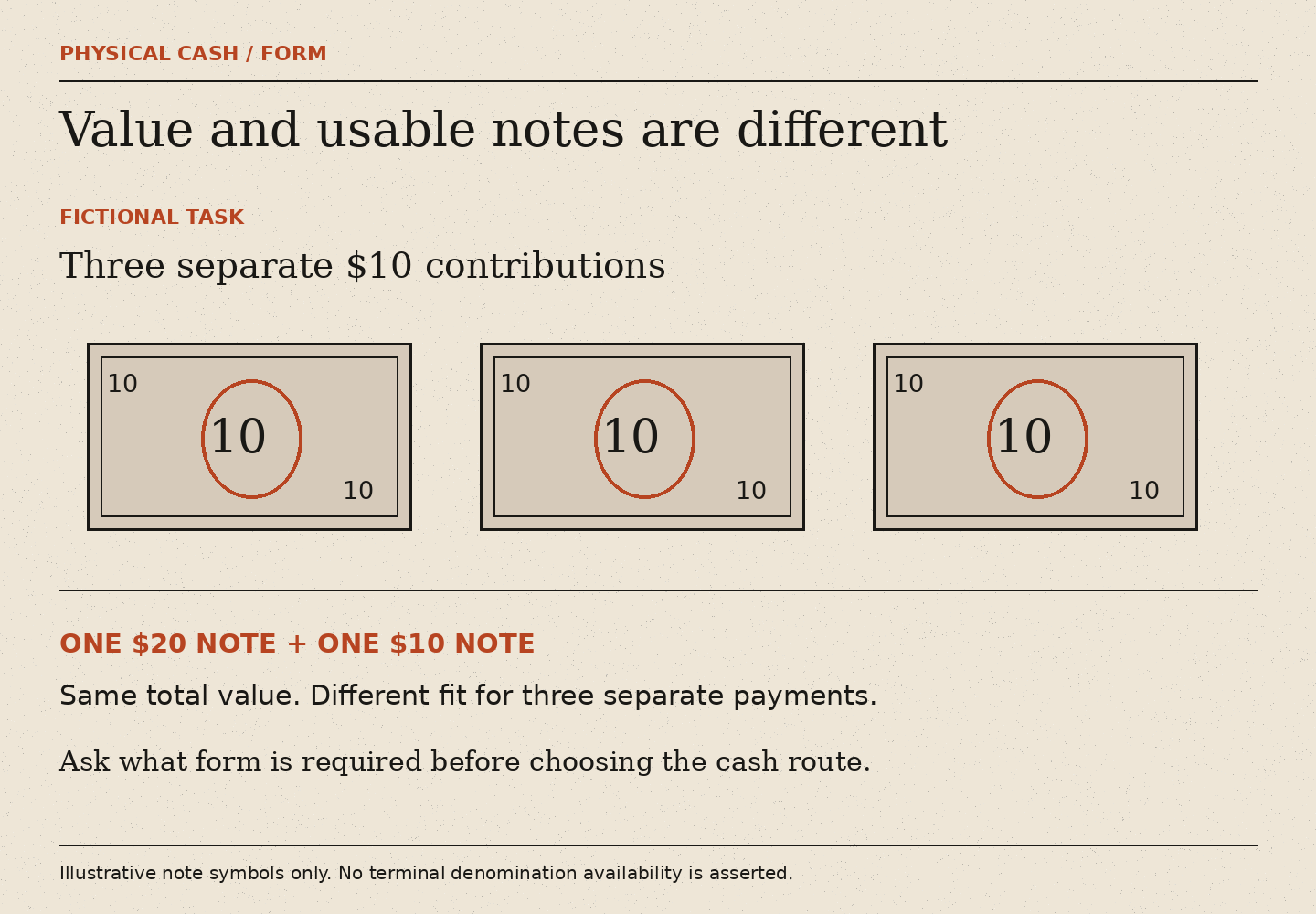
Imagine a reader who needs three separate ten-dollar contributions for an invented club activity. Candidate A is convenient but has no confirmed note information. Candidate B is farther away and is described by its operator as offering several note choices, subject to availability. Candidate C is not an ATM at all: the club organizer has agreed to accept a single contribution covering the group.
These options solve different problems. Candidate A may leave the original distribution problem untouched. Candidate B may offer the desired form but requires a longer trip and still has an arrival-only uncertainty. Candidate C changes the recipient’s requirement, provided the organizer actually agrees. The reader should not treat a more flexible machine as automatically superior to a simpler agreement with the recipient.
The comparison can be recorded in three columns on paper: required form, evidence about the option, and unresolved condition. No account amount needs to enter this website. The artifact is a compatibility check, not a recommendation about spending, saving, or which financial service to use.
Close the loop with the cash recipient
If the notes you receive differ from the plan, reassess before heading straight to the next destination. The recipient’s ability to make change may vary during the day. A previous exception may not apply again. Ask rather than treating a past courtesy as a standing arrangement. Respect a clear exact-cash requirement instead of arriving with a problem someone else must solve.
There is also a practical handling question. Several small notes can be easier to allocate but more cumbersome to count and carry. Choose an orderly private way to keep them without displaying cash unnecessarily in the venue. The aim is to finish the intended task, not merely to optimize the contents of a wallet.
A good denomination plan ends with a sentence: “This visit works if the available notes satisfy the actual payment requirement; otherwise I will use the already-agreed alternative or defer the task.” That sentence prevents a mismatch of physical form from turning into unnecessary travel, extra transactions, or an improvised purchase for change.
Sources and limits
Public sources checked October 14, 2026. The methods, fictional places and illustrations are original editorial work. No source review establishes live terminal availability, venue access, card eligibility or guaranteed cost.
- Corpay Prepaid ATM locator · Public candidate-location interface; no location submitted, no live terminal status, access or eligibility verified.