In this article
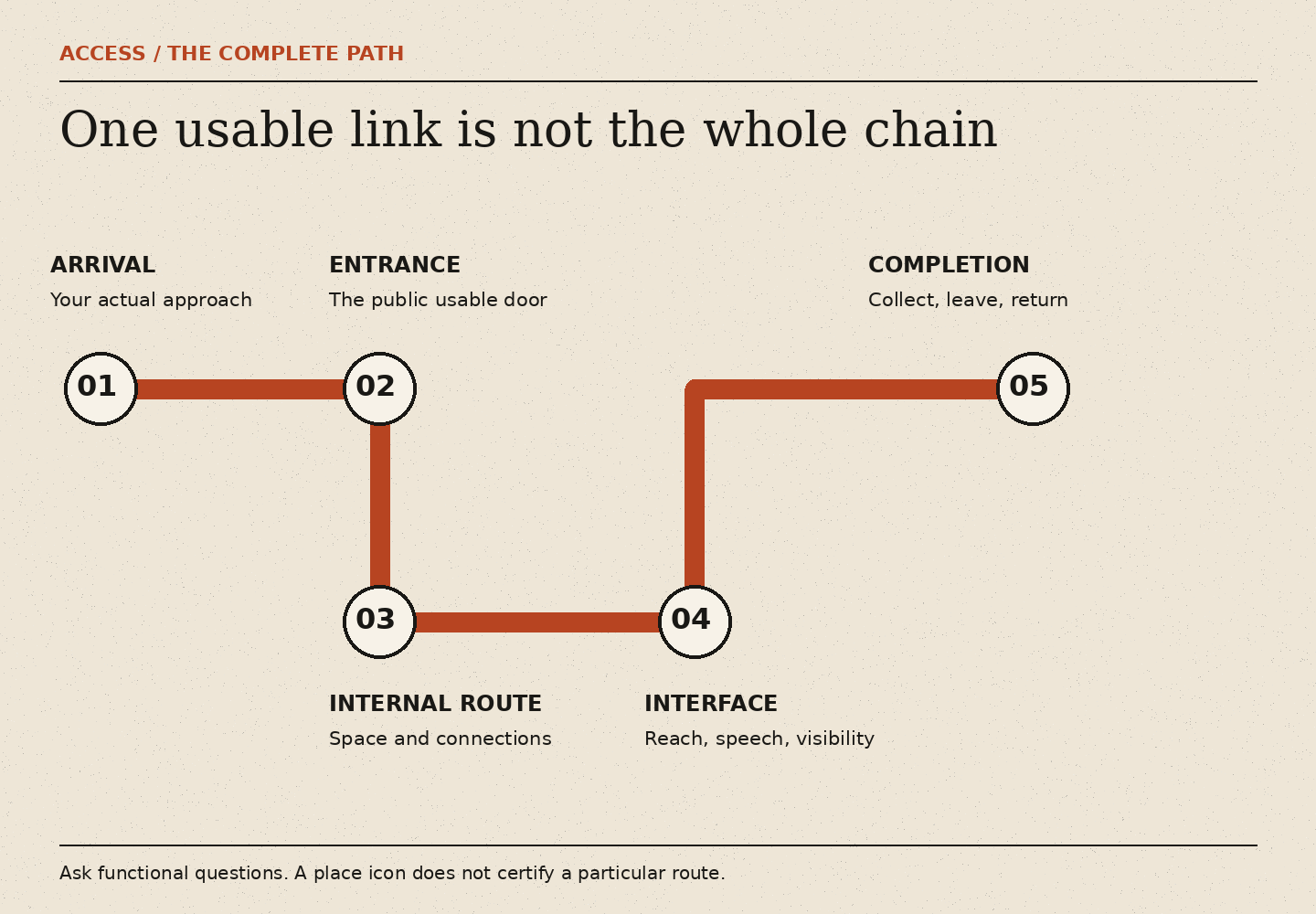
A terminal can have accessible features while the journey to it remains unusable for a particular reader. The curb approach, entrance, door, internal route, clear space, controls, screen, and output all contribute to the visit. Treating accessibility as one icon on a locator misses the sequence. A useful plan starts with the conditions you need and follows them through the whole route.
This article offers a practical inquiry method, not an accessibility certification or legal assessment of a venue. The U.S. Access Board’s ATM provisions address matters including clear space, operable parts, privacy, speech output, input controls, and displays. Those standards provide context for specific questions. They do not establish the current condition of a machine you have not inspected.
Describe the task, not your medical history
You can ask for an entrance without steps, a usable approach to the controls, or information about speech output without sending a diagnosis to a venue or this publication. A functional question is often easier for someone on site to answer: “Can I reach the ATM from the public entrance without using stairs?” is more concrete than “Is everything accessible?”
Choose the conditions relevant to you. Some readers need a level route and maneuvering space. Others need speech output, readable contrast, tactile controls, sufficient time to understand prompts, or a quiet enough setting to use an audio feature. A companion’s presence can help with orientation, but it should not be assumed as a substitute for independently usable equipment.
Keep access needs separate from the card’s transaction requirements. A reader may be able to use the machine physically yet lack the specific card feature needed for the intended function. Conversely, a card can support cash access while the machine’s physical arrangement prevents the reader from using it. Combining these into one “works for me” label hides the source of a barrier.
Trace the route from arrival to departure
Begin where you actually arrive: a sidewalk, parking space, transit stop, or drop-off point. Find the usable public entrance from there. Consider whether an entrance shown in a building directory reaches the terminal during the intended hours. A step-free side entrance can be a poor plan if it is locked while the main door remains open.
Inside, ask about the route rather than only the final position. Temporary displays, furniture, queues, or a narrow turn can matter. You do not need to collect measurements for every visit; you need enough information to judge whether the route is plausible for your circumstances. When the answer is uncertain and the trip would be costly, seek a more specific description or choose a different candidate.
Departure deserves the same attention. A route that is manageable on arrival may be harder after a queue, fatigue, or a change in weather. The cash task should fit within the entire journey. Do not let a successful terminal encounter obscure the need for an equally usable way out and onward.
Make the interface questions concrete
For speech output, ask how the feature is initiated and what equipment a user needs to bring, if any. Do not assume that a visible socket is working or that a familiar headphone connector will fit every terminal. The machine’s operator is a better source for equipment details than a generic venue directory. Follow the terminal’s own instructions when you arrive.
For reach and visibility, consider the position from which you use the machine. A screen that is clear from a standing viewpoint may be difficult from a lower position or under glare. Controls may be within reach while the cash or receipt outlet is awkward. A plan that considers only the first button ignores the completion of the transaction.
For comprehension, an unfamiliar interface may require more time. Choose a visit window that allows you to read or listen without feeling rushed by your own transport deadline. This does not guarantee that the terminal will offer additional time. It simply avoids adding an unnecessary external pressure to the interaction.
A fictional access chain with a hidden break
Jordan is a fictional reader who uses a mobility aid. A candidate ATM is inside a municipal service building. The venue confirms a step-free entrance on the east side and an ATM in the main lobby. At first the plan appears straightforward. A second question reveals that the east entrance reaches an elevator lobby that closes before the building’s evening event entrance.
The relevant problem is now clear: an accessible route exists during one window but has not been confirmed during Jordan’s intended visit. The ATM’s own features do not resolve that gap. Jordan can change the visit time, ask the venue about another public route, or choose a candidate whose usable entrance matches the intended window.
Jordan records the limitation as “east route confirmed during ordinary service hours; evening route unconfirmed.” That is more accurate than marking the entire venue accessible or inaccessible. It also avoids judging other readers’ needs from one person’s route. The record is a practical description of a specific chain at a specific time.
Keep assistance within the boundary you choose
If another person is helping with navigation, decide beforehand what help is wanted. They can describe a sign, locate an entrance, or identify an available seat without handling the card or learning a PIN. A venue employee’s willingness to assist does not establish authority to operate an account. Keep private authentication steps private and use official support if the equipment cannot be used as intended.
You may decide to stop rather than accept an improvised workaround. That is a legitimate result of planning. The fact that someone offers help does not obligate you to disclose personal information, surrender control of a transaction, or continue with an arrangement that does not suit your needs. A useful route preserves choice as well as physical access.
If you want to report a barrier, describe the observable feature and the affected task. “The approach was blocked by a display on this date” is more actionable than “The ATM is bad.” Send a report to the appropriate venue or operator contact. This publication can discuss its own articles, but it cannot investigate a site or determine legal compliance.
Build a personal access chain
A short chain can read: arrival point, usable entrance, internal route, controls and information, output collection, departure. Mark each link as confirmed, uncertain, or dependent on arrival conditions. Add the source and date only where that information is useful. Do not include health records or a detailed personal explanation in a public planning tool.
The strongest alternative addresses the weak link. If the concern is a locked side entrance, a second terminal inside the same route does not help. If the concern is the interface, a different venue with the same unverified equipment may not solve it either. Choose a fallback based on the barrier you are trying to avoid, and retain the option to end the visit without completing a transaction.
Sources and limits
Public sources checked October 14, 2026. The methods, fictional places and illustrations are original editorial work. No source review establishes live terminal availability, venue access, card eligibility or guaranteed cost.
- ADA Accessibility Standards, Section 707 · ATM features including clear space, controls, speech and display; not certification of a specific venue or legal advice.