In this article
A backup ATM is only useful if you can reach it after the first option fails. A second map pin may be in the wrong direction, behind the same locked door, or beyond the last workable connection. Route planning improves when you think in paths and shared dependencies rather than simply counting candidate machines.
This guide uses an original route exercise with fictional places. It does not calculate fares, predict travel times, select a live terminal, or recommend a particular withdrawal. The goal is to build a trip that still has a sensible next step when one condition changes. A graceful failure might mean visiting an alternative. It might also mean returning home without cash and without turning a small task into an exhausting search.
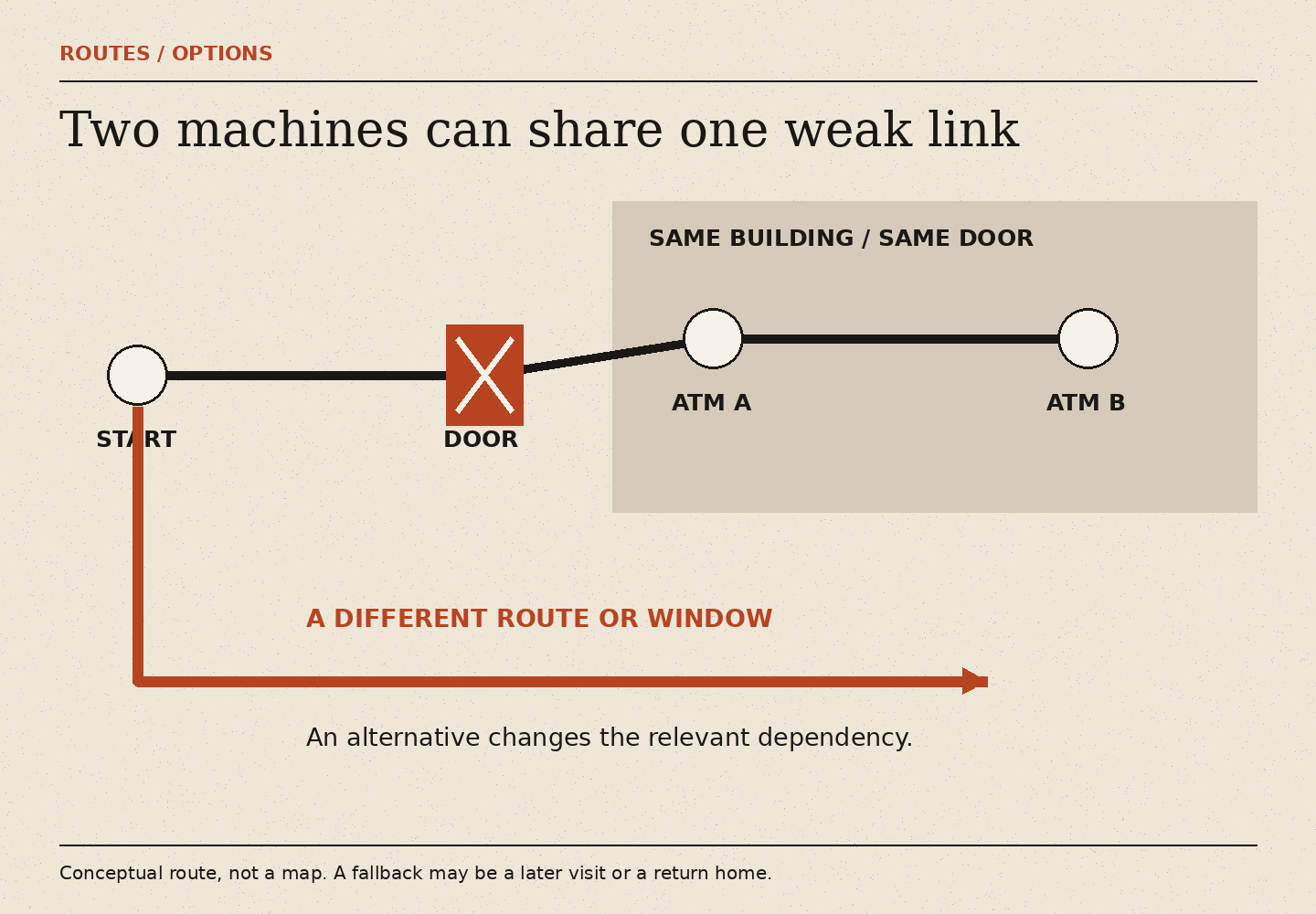
Draw the trip as a small network
Put the starting place, candidate A, candidate B, the onward destination, and the return point on a simple sketch. Connect only the journeys you can realistically make. Label a connection with its important condition: a particular bus service, a usable crossing, a public entrance, a ride from another person, or an opening window. Exact coordinates are unnecessary for this exercise.
The sketch reveals whether B is actually a fallback from A or merely another option from the starting point. If going to A first makes B unreachable, the two candidates are alternatives before departure, not a sequence. That distinction matters when the first stop is uncertain. You may need to choose between them at the beginning rather than promise yourself both.
A route also includes the way out. It is easy to draw arrows toward cash and omit the return. Add the return connection before judging the plan. If the last stage depends on a service with a limited schedule, that constraint affects every earlier decision. A destination that is easy to reach can still be difficult to leave.
Look for shared failure conditions
Suppose two terminals are inside different stores in the same enclosed mall. They may share the mall’s public opening hours, transit stop, parking access, or temporary closure. If your principal uncertainty is the mall entrance, adding a second terminal does little to reduce it. The plan has two machines but one doorway.
Now suppose candidate B is in a different venue along the return route. It may avoid the doorway dependency but share a network question that has not been resolved for your card. The alternative is stronger in one respect and unchanged in another. Describe that honestly rather than calling it fully independent.
A useful backup changes the failure condition you are most concerned about. It does not need to be different in every possible way. If the first venue’s hours are uncertain, choose a fallback whose public access is better understood. If the first route depends on a difficult crossing, investigate a route that avoids that crossing. More distance can be worthwhile when it removes the actual bottleneck, but distance alone is not the test.
Work through a fictional route
Rosa is traveling from an invented residential stop to a public library event. Candidate A is inside a plaza near the event. Candidate B is inside a food market on the route home. Rosa can reach either from the bus line, but the market closes earlier than the plaza. The bus service becomes less frequent later in the evening.
If Rosa visits A first and spends time locating the correct entrance, B may no longer be usable. The original idea, “try A, then B,” is therefore misleading. Rosa redraws the sequence: investigate B on the way to the event, with A remaining a possible later option only if its entrance and the return trip still fit. Alternatively, Rosa can decide that a failed B visit ends the cash task for that day.
The correct sequence depends on Rosa’s actual purpose, energy, and travel constraints. This example does not tell readers to favor early-closing venues. It demonstrates how a closing time can change the direction of a fallback. A route that looks inefficient on a map may preserve more meaningful options in time.
Set a decision point before moving
A decision point is a condition that tells you whether to continue to the next candidate. It should be observable. “If the public door is locked, use the return route” is clear. “If this takes too long” is less useful unless you know what “too long” means for the connection or commitment you need to preserve.
You can use a departure time, the next transport connection, a physical access issue, or an unresolved terminal disclosure. The point is to choose the rule while you are still able to consider the whole trip. At the destination, effort already spent can create pressure to keep going. A prior decision point helps keep that pressure from silently changing the scope of the errand.
Do not make the fallback dependent on repeated transaction attempts. If the first encounter raises an account or authorization question, a route to another terminal may not be the appropriate next step. Use the official card-support route when the issue concerns the account. The travel sketch is a logistical tool, not a diagnostic procedure.
Compare routes without reducing everything to money
A route can be assessed by number of uncertain links, number of fixed connections, entrance clarity, physical effort, and whether it preserves an easy return. These are categories, not a universal score. Two readers can reasonably choose different routes because the same walk, queue, or wait affects them differently.
Avoid assigning false precision to information you do not have. If a walking estimate ignores an inaccessible crossing or the internal route through a large venue, it is not the relevant journey time. If a transit schedule is outdated, a neat calculation only makes the wrong assumption look authoritative. Check the source that governs the uncertain link instead of refining arithmetic around it.
The official provider locator can supply candidate places, while the route and venue sources supply different parts of the trip. Keep those roles distinct. No map result in this guide establishes live availability, the cost of a withdrawal, or your card’s eligibility.
Finish with a route you can explain in one breath
A usable plan might read: “Try the market on the outward route; if its entrance or terminal does not fit, continue to the event; consider the plaza only if the return connection remains comfortable.” This is a sequence with a stopping condition, not a promise to obtain cash at all costs.
Keep a version you can consult without navigating several open pages. It may be a private paper note with the entrance descriptions and return option. The value is not the drawing itself. It is the ability to see which choices remain available after the first thing goes differently from the plan.
Sources and limits
Public sources checked October 14, 2026. The methods, fictional places and illustrations are original editorial work. No source review establishes live terminal availability, venue access, card eligibility or guaranteed cost.
- Corpay Prepaid ATM locator · Public candidate-location interface; no location submitted, no live terminal status, access or eligibility verified.