In this article
An ATM can be close and still be the wrong destination. It may sit beyond a locked lobby, on the far side of a road without a usable crossing, or inside a building whose public entrance closes before the machine does. The card may support cash withdrawals while a particular terminal cannot provide the notes you need. None of these problems becomes visible when a search result is reduced to a distance and a logo.
This guide treats a cash visit as a short journey with several conditions. Its purpose is to help you decide what must be known before setting out, what can only be learned at the destination, and when an alternative is genuinely useful. It does not identify a currently working ATM, authorize a withdrawal, or promise a price. Your actual card terms and the terminal’s own information remain separate from the route you plan.
Fintwist is now Corpay Prepaid, according to the provider’s current home page. Corpay presents PayCard as a payroll product and FlexCard as a product for business disbursements such as incentives and reimbursements. Those labels orient the reader; they do not establish identical cash-access features, fees, or restrictions for every program. Use the agreement and official materials for your own card when a decision depends on those conditions.
Define a successful visit before choosing a machine
“I need an ATM” describes equipment. It does not describe the outcome. A better private planning sentence might be: “I need usable cash before visiting a cash-only community sale, and I need to return by the next scheduled bus.” That sentence introduces the destination after the withdrawal and the route home. It also tells you which uncertainties matter. A machine that dispenses only large notes could leave the intended task unfinished even after a successful withdrawal.
Keep the sentence simple. Name the use of cash, the broad visit window, and one nonnegotiable access condition. There is no need to put a card number, available balance, actual address, or reason for needing cash into this publication’s tool. You can think through the categories without making a record of private financial details. If a planning aid asks for much more than the trip requires, consider whether you need that aid at all.
Then distinguish essential conditions from preferences. An entrance you can use is essential. A shorter walk may be a preference until fatigue, limited mobility, weather, or a connection makes it essential too. Smaller notes may be optional for one errand and necessary for another. Your own circumstances set those boundaries. A general article cannot rank them for you.
Read the trip as five connected stages
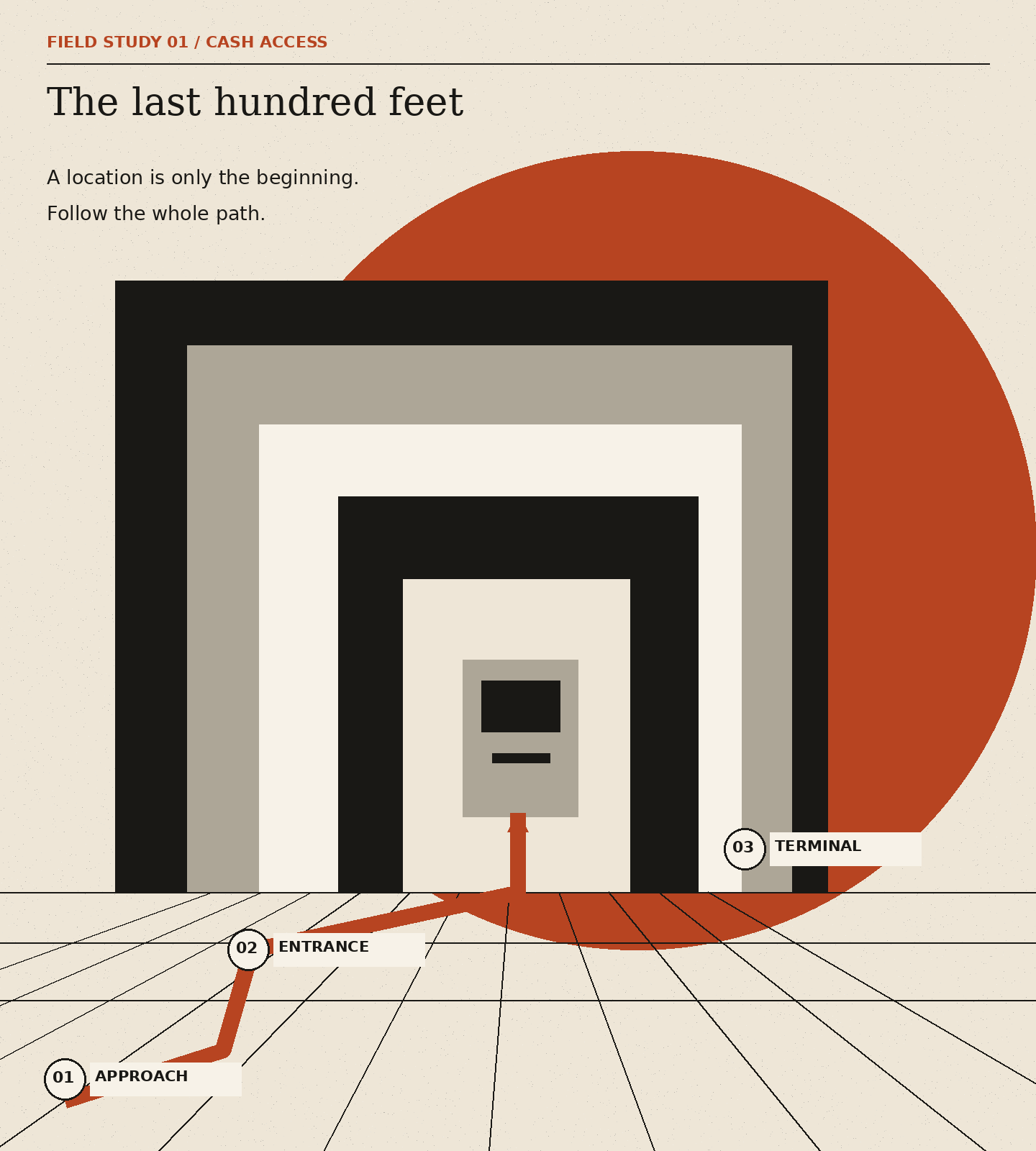
First comes the card condition: whether your particular card and program support the intended cash access and what instructions apply. Second comes the network evidence: which official source identifies a potentially suitable terminal. Third comes the place: whether you can reach and enter the venue at your intended time. Fourth comes the terminal encounter: the available functions, disclosures, note options, and transaction result. Fifth comes completion: putting the cash away, leaving the venue, and continuing or returning by a workable route.
A weakness in one stage does not automatically invalidate every other stage. If the public entrance is closed, the problem is venue access, not proof that your card is defective. If the terminal offers unsuitable denominations, the route may have worked even though the cash task did not. Keeping the stages separate makes the next step more precise and prevents an unproductive search for one explanation that covers everything.
The stages also prevent premature confidence. A locator entry establishes a candidate, not a completed trip. A store’s hours do not establish the ATM’s condition. A visible machine does not establish your card’s program terms. Reaching the fifth stage means the visit is finished on your own terms, not merely that you managed to start a transaction.
A fictional journey with two plausible destinations
Consider Devon, a fictional reader traveling by bus to a weekend makers’ sale. Devon has already checked the relevant card instructions privately. Two candidate ATMs appear in an official locator. One is inside a shopping center near the sale. The other is inside a grocery store along the bus route. These are invented places and conditions, not live recommendations.
The shopping-center option is geographically closer to the sale, but the map pin points to a service road. The public entrance is on the opposite side of the building, and Devon cannot confirm whether the interior corridor opens before the sale begins. The grocery-store option requires a slightly longer walk but has a known public entrance on Devon’s route. It also leaves time to abandon the cash visit and continue home if the terminal cannot be used.
The useful comparison is not “near versus far.” It is “a short but unresolved access chain versus a longer, more understandable chain.” Devon chooses to investigate the grocery option first. That decision still says nothing about whether the machine will be working or whether any withdrawal will cost a particular amount. It is a logistical choice based on the parts of the visit that can be compared beforehand.
Devon also asks the sale organizer, through an appropriate public contact, whether large notes are practical. The organizer says vendors may not have change early in the morning. That information changes what counts as success. Devon does not simply withdraw more money to solve a denomination problem. Instead, the plan includes verifying note options and accepting that a cash-only purchase may need to be skipped if usable notes are unavailable.
Gather only evidence that can change the decision
There is a difference between a useful check and an endless research exercise. If both candidates require crossing the same closed pedestrian bridge, confirming a third storefront’s opening time will not resolve the route. Identify the current bottleneck. Ask the source that can answer that bottleneck, then reassess. The card provider can address program instructions. A venue can describe its entrance. A terminal operator may be able to describe machine functions. None of those roles can reliably answer every question.
A short private evidence note can use three labels: known, uncertain, and arrival-only. “The entrance is on the south side, according to the venue” is known within the limits of that information. “Small notes may be offered” is uncertain. “The machine has cash right now” is generally an arrival-only condition unless you have a reliable current source. The point is to expose assumptions, not to turn yesterday’s observation into a guarantee.
Record when a time-sensitive fact was checked. A regular opening schedule and a holiday exception are different pieces of evidence. A saved locator result is useful for identifying a candidate, but its date does not make it live inventory. If a source gives no answer, retain the uncertainty rather than filling the gap with an optimistic guess.
Give the alternative a different failure condition
Two ATMs inside the same shopping center may share the same closed door. Two venues reached by the same infrequent bus may share the same missed connection. A useful alternative changes the relevant vulnerability: another entrance arrangement, another route, a different visit window, or a later attempt that avoids an unresolved condition. More dots on a map do not automatically create resilience.
For Devon, a second machine inside the same unopened corridor is not a meaningful alternative. Returning another day might be more realistic than walking to a third uncertain destination under time pressure. That can feel less productive, but it preserves the ability to make a deliberate choice. A fallback does not have to produce cash immediately to be useful; it must provide a sensible next action if the original visit fails.
Set the point at which you stop extending the trip. This could be the return-bus departure, the close of the usable entrance, a physical access problem, or simply the moment the remaining options no longer fit your circumstances. The stop condition belongs to the route, not to the amount of effort already spent. A long walk already completed is not a reason to accept a new problem at the terminal.
What to do with the information at arrival
Before starting, check that the machine and entrance match the place you planned. Read the terminal’s available information and follow the official instructions for your card. If an unexpected disclosure or function changes the decision, pause rather than treating the journey as a commitment to proceed. Do not use a general article as permission to ignore a charge screen or guess an unfamiliar transaction selection.
A completed visit also deserves a moment of closure. Put away the card and cash, retain any needed record privately, and confirm the next part of the route before moving on. If there was a transaction problem, use the official account-support route appropriate to your card; this magazine cannot diagnose it. If the problem was logistical, record the narrow observation so the next visit starts with better information.
The practical result is a five-line brief: the intended outcome, the card condition to verify privately, the place and entrance, the arrival-only questions, and the next route if this one does not work. The Cash Visit Planner helps organize those categories. It deliberately has no map, balance field, or “best ATM” answer. The reader’s job is to make the trip understandable before making it longer.
Sources and limits
Public sources checked October 14, 2026. The methods, fictional places and illustrations are original editorial work. No source review establishes live terminal availability, venue access, card eligibility or guaranteed cost.
- Corpay Prepaid current home page · Name transition; PayCard and FlexCard context; card-specific conditions remain in actual agreement.