In this article
A cash machine may display a bank name, a network mark, an operator label, and the host store’s branding in the same small space. Your card carries another set of names. When a question arises, the visible name closest to the machine is not necessarily the organization that can answer it. Understanding the roles helps you ask a narrower question and avoid treating every cash-access issue as a card-account problem.
This is a map of responsibilities for planning purposes, not a legal determination of any organization’s duties. Actual arrangements vary. A venue might own its terminal, a separate operator might run it, and a financial institution might have more than one role. The useful distinction is the kind of question each role can reasonably address, not a claim that every site has exactly four separate companies.
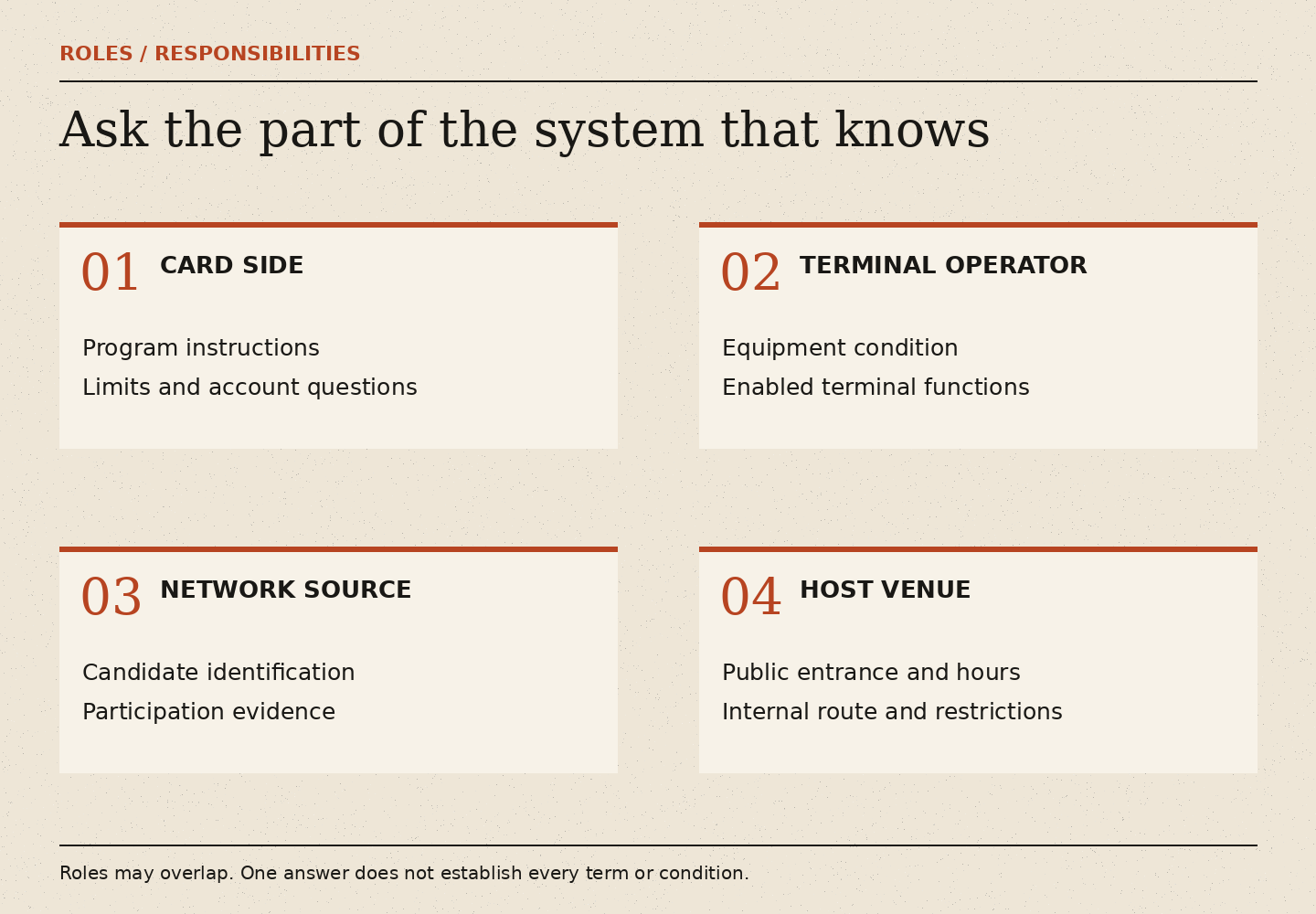
The card side: terms and the account relationship
Your card’s issuer and program materials are the starting point for questions about the card itself: supported cash-access methods, applicable limits, fees charged under the program, and official transaction instructions. Corpay’s current public pages distinguish PayCard payroll from FlexCard business disbursements. That distinction is a reason to identify your actual arrangement rather than borrow instructions from someone else’s card.
A product overview is not a personalized account assessment. It does not establish your available balance, the state of your card, or the terms of a specific employer or payout program. Those questions belong in your own verified materials or official account-support channel. The Cash Atlas does not collect the information needed to answer them and should not receive it.
When preparing a support question, separate what you need to learn from what you assume. “Which official cash-access instructions apply to this card?” asks for a source. “Why does every ATM reject this card?” may generalize from one encounter and assume a diagnosis. A precise question gives support a better starting point without requiring you to circulate account details among unrelated organizations.
The terminal side: the equipment and its operation
The terminal operator is concerned with the machine and its operation. The identifying information may be on the equipment or transaction record. An operator may be able to receive a report that the machine is out of service, that a screen is unreadable, or that a physical feature is not working. It may not control the card program’s restrictions or be able to explain an issuer’s decision.
For planning, keep a machine identifier distinct from a street address when one is available. A large venue can contain multiple terminals. “The machine near the north entrance” may identify a place better than “the ATM in the store,” while a terminal number can distinguish equipment more precisely. Retain those details privately if they are relevant. There is no reason to post a transaction receipt to a public review page to explain a logistical problem.
The operator’s surcharge and a fee charged under the card program are different questions. The CFPB’s prepaid-disclosure guide explains that ATM fees can differ by network and that the full disclosure contains additional terms. This article does not calculate a total. Its point is that one organization’s answer should not be treated as a complete statement of another organization’s charges.
The network side: a relationship, not a building
A network links participating arrangements and terminals. A network name can help identify which official locator or provider instructions are relevant. It does not tell you whether a shopping-center door is open, whether a particular machine currently has cash, or whether your card’s precise program has the benefits you expect. Physical branding and program participation are related questions, but they are not interchangeable evidence.
Start from the network information in your actual card materials or provider-supported locator. Do not infer participation from an old employer handout, another person’s successful visit, or a familiar logo alone. If sources conflict, preserve the specific conflict for the card provider to resolve. “The card instructions name this network, but this terminal is not in the current locator” is much clearer than “The sign says free.”
The network role also explains why the host business may have little information about the card. Staff can often point to the machine yet have no visibility into the relationship between that terminal, a network, and your card program. Their uncertainty is not evidence of a problem with the card; it is a boundary of their role.
The venue side: getting to the equipment
The host venue controls or understands the physical setting: customer entrances, hours, interior directions, access restrictions, and sometimes maintenance contacts. These are valuable facts. They should not be dismissed because the venue cannot answer account questions. A perfectly correct card instruction is not useful if you cannot reach the equipment to which it applies.
A venue question might be: “Is the cash machine in the public lobby or inside the ticketed area?” Another might be: “Which accessible entrance reaches that part of the building during evening hours?” Neither requires telling the venue the card balance or the reason for withdrawing. Keep the conversation on the piece of the trip that the venue can describe.
If a venue employee offers a broad statement about fees, recognize its limits. They may be describing the machine’s posted charge, a common customer experience, or an arrangement for a different card. You can thank them for the information while still checking the terms that apply to your card. Courtesy does not require treating every statement as comprehensive financial guidance.
A fictional question-routing exercise
Mina reaches a fictional station concourse and finds the ATM behind a closed internal gate. The venue information desk is the first useful source, because the immediate problem is access to the concourse. Calling card support would not open the gate. Mina learns that a different public entrance reaches the same area during ordinary operating hours and decides whether that route fits the trip.
On another visit, the terminal displays a function Mina does not recognize. Now the venue’s entrance knowledge cannot answer the question. Mina ends the attempt if needed and checks the official card instructions. Later, a damaged headphone socket becomes an equipment report, while the question of which network applies remains a card-program question. The same address has produced different questions for different roles.
Create a four-line routing note: card terms to the card’s official support; equipment condition to the identified operator; network applicability to the verified program source; entrance and hours to the venue. If the first contact redirects you, ask which question the next contact can answer. This keeps the information moving with a purpose and avoids retelling an entire account story to people who only need a doorway description.
Sources and limits
Public sources checked October 14, 2026. The methods, fictional places and illustrations are original editorial work. No source review establishes live terminal availability, venue access, card eligibility or guaranteed cost.
- Corpay PayCard product overview · Payroll positioning only; not an individual card capability or fee assessment.
- Corpay FlexCard product overview · Business-disbursement positioning including incentives and reimbursements; no universal ATM-feature inference.
- Understand your prepaid card disclosure · Network-related fee distinction and full-disclosure context only; no personalized calculation.